


NSW NIV Investor ROI: Separating Personal Capital, Fund Size and Investment Figures
Prepare consistent financial figures for an NSW innovative investor ROI by distinguishing paid capital, commitments, fund size and personal finances, with clear dates, currencies and roles.
For an NSW National Innovation visa innovative investor Registration of Interest, describe what each financial figure actually measures. A fund's size, your personal assets and the amount you have invested are different facts. NSW's ROI guide asks applicants to explain their financial figures and, for investors, their deal amounts, investment stages, roles and significant outcomes. Resolve those definitions before submitting the form, rather than leaving a reviewer to infer them from a large headline number. NSW — Guide to Registering Your Interest
This is preparation for NSW nomination. It is not an application assessed only on wealth. The innovative investor pathway also concerns your contribution to ventures and the investment community, together with your intended involvement in NSW. Clear financial records support an accurate account; they do not establish that you meet every nomination or visa requirement. NSW — Innovative Investors
Give each figure a defined owner and purpose
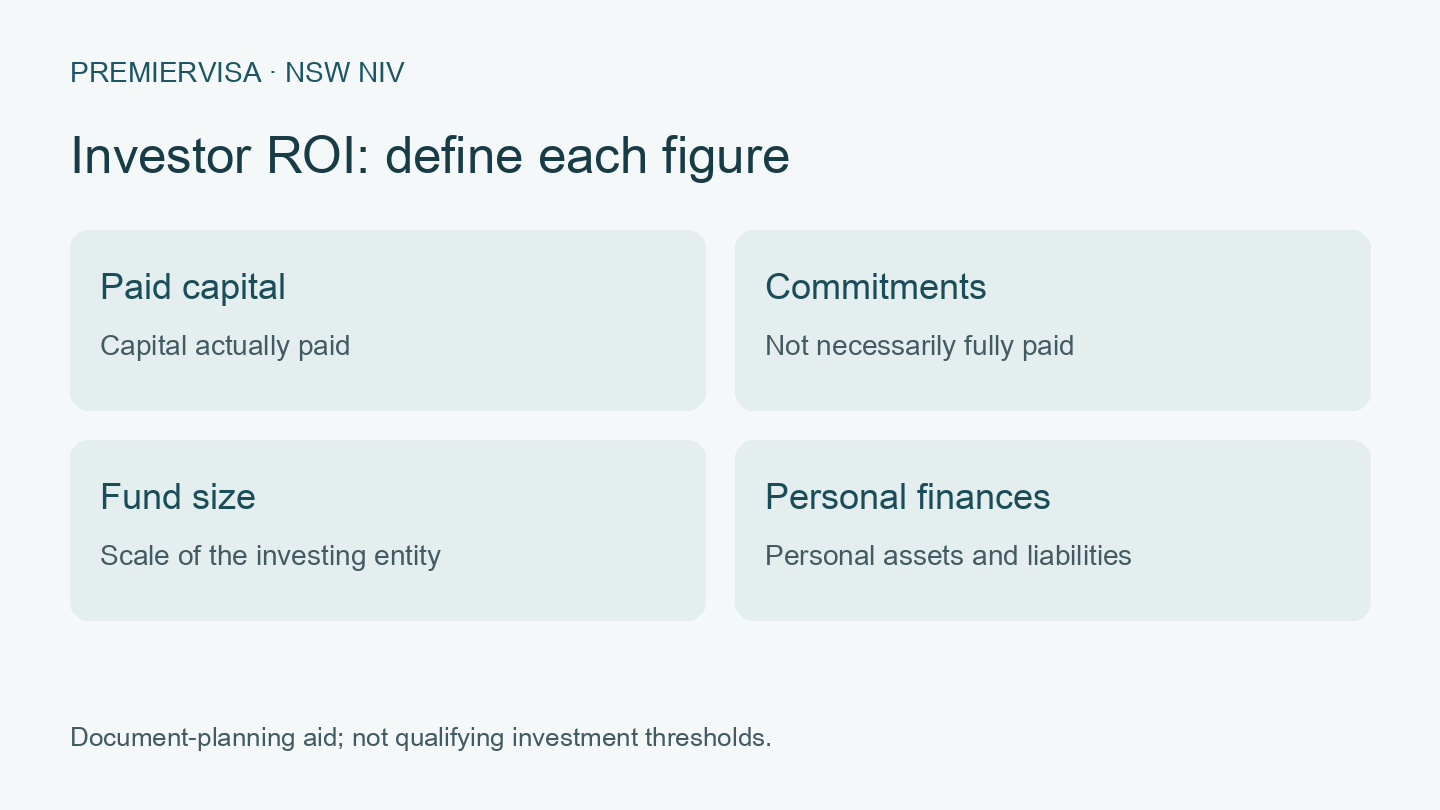
Start with capital you have actually paid. Identify whether you invested directly or through a holding company, fund or special purpose vehicle. Then separate commitments that have been signed but not fully paid. An agreement can establish a commitment without establishing that every dollar has already reached the venture. If both figures matter, show them separately and explain the relationship.
Next identify the fund or platform figure. It might represent assets under management, aggregate commitments or the size of one fund vintage. None of those descriptions automatically makes the amount your personal wealth or the value of investments you personally selected. Personal financial standing is another category again. A record of assets and liabilities answers a different question from a history of investments in innovative businesses.
Use the definition that fits the question and the underlying records. Do not select whichever number is largest. If a field does not provide enough space to explain a complex structure, obtain appropriate guidance on presenting the information accurately. A compressed entry should still be true; an ambitious interpretation can become difficult to reconcile when supporting documents are requested.
Build a transaction schedule before writing the narrative
A private working schedule can record the venture, legal investing entity, transaction date, currency, amount committed, amount paid, type of interest and your role. This is an organisational method, not an additional government form or a prescribed qualifying investment threshold. Its purpose is to let you check each statement against a record that exists.
For a company supported across several funding rounds, keep each round distinct and calculate the cumulative amount separately. Otherwise a summary can count individual rounds and then add the cumulative total a second time. Retain original currencies. If you provide a converted figure, identify the exchange-rate source and conversion date, rather than silently comparing historical dollar amounts on different bases.
NSW's supporting-document guide gives examples such as investment contracts, deal memoranda and portfolio holdings records. It also asks for material explaining the structure of investment capital, including fund overviews, SPV documentation or evidence of personal capital. These records should connect to the figures you use. A document with the right title does not resolve an unexplained discrepancy between two amounts. NSW — Guide to Supporting Documents
Connect the investing entity to your own contribution
Where a company or fund made the investment, explain both your relationship with that entity and your actual involvement in the transaction. Ownership, office held, signing authority and investment decision-making authority are not necessarily the same. An organisation chart can identify a relationship but may not explain what you did on a particular deal.
For a committee decision, describe the analysis, vote, negotiation or subsequent support for which you were responsible. A fund subscriber should not describe every portfolio company's development as their own operating achievement. NSW lists board minutes, advisory agreements and shareholder communications among examples of evidence of personal involvement. Use genuine contemporaneous material to describe the role you held, within the limits of what it proves. NSW — Guide to Supporting Documents
If your role changed over time, reflect that chronology. Sourcing a deal before joining a fund, participating in an investment decision after joining it and advising the company later are distinct activities. You can describe all three where supported, without rewriting them as continuous control of the venture. Consistent dates help readers understand the connection between your appointment, the investment and the outcome.
Keep valuations, revenue and exit proceeds separate
A higher valuation at a financing round does not mean you received that value in cash. A portfolio company's revenue is not your personal income. For an exit, distinguish an executed sale, consideration received and consideration still conditional or unpaid. These distinctions make the account verifiable; they do not imply that a particular return automatically qualifies someone for nomination.
Periods matter as much as definitions. Annual revenue, assets on a specified date and cumulative investment across several years should not be presented without dates as though they were directly comparable. For co-investments, you may describe the total funding round as context, but identify the relevant investor's contribution separately. The round's aggregate proceeds should not silently become your individual investment figure.
Resolve inconsistencies before submission
NSW explains that an ROI cannot be edited after submission. Documents are not uploaded at that initial stage, but you must be ready to substantiate claims if invited to apply. Compare the draft ROI with your records while corrections remain possible. If an old pitch deck, biography and signed agreement disagree, establish why and use a statement supported by the evidence. NSW — Guide to Registering Your Interest
For confidential fund or portfolio material, confirm disclosure permissions before sharing it. Do not assume that extensive redaction will necessarily leave sufficient evidence, or place sensitive commercial records in a public article or a general enquiry form. NSW's current supporting-document guide requires certified translations for documents that are not in English. Plan that work using the applicable instructions, rather than treating an informal translated summary as automatically sufficient. NSW — Guide to Supporting Documents
For an initial discussion, prepare a transaction index without sensitive details, a factual description of your role and a list of figures already supported by records. PremierVisa can help organise material and questions for assessment. Whether the complete record meets nomination and visa requirements remains a separate, individual assessment under the relevant rules.
NSW — Guide to Registering Your Interest