Does NSW NIV Investor Nomination Require a Completed Local Investment First?
NSW lists existing investments, future investment strategy and local networks as evidence of intent. Describe opportunities accurately without presenting introductions or diligence as completed deals.
A completed investment in NSW should not be presented as a universal formula for obtaining National Innovation visa investor nomination. NSW lists existing investments, a future investment strategy and engagement with local investment networks or partners as possible evidence of local investment intent. Those examples show why a payment record is only one part of the enquiry. The complete assessment also concerns your track record, personal contribution and intended involvement in the state. NSW — Innovative Investors
Understand what a deal pipeline can show
NSW's investor supporting-document guide asks for details of a pipeline of local opportunities. Its examples include pitch decks, early-stage deal memoranda and due diligence notes. It also identifies local connection material such as meeting notes with NSW startups or funds. These can describe opportunities under consideration; they do not require you to portray every conversation as a completed transaction. NSW — Guide to Supporting Documents
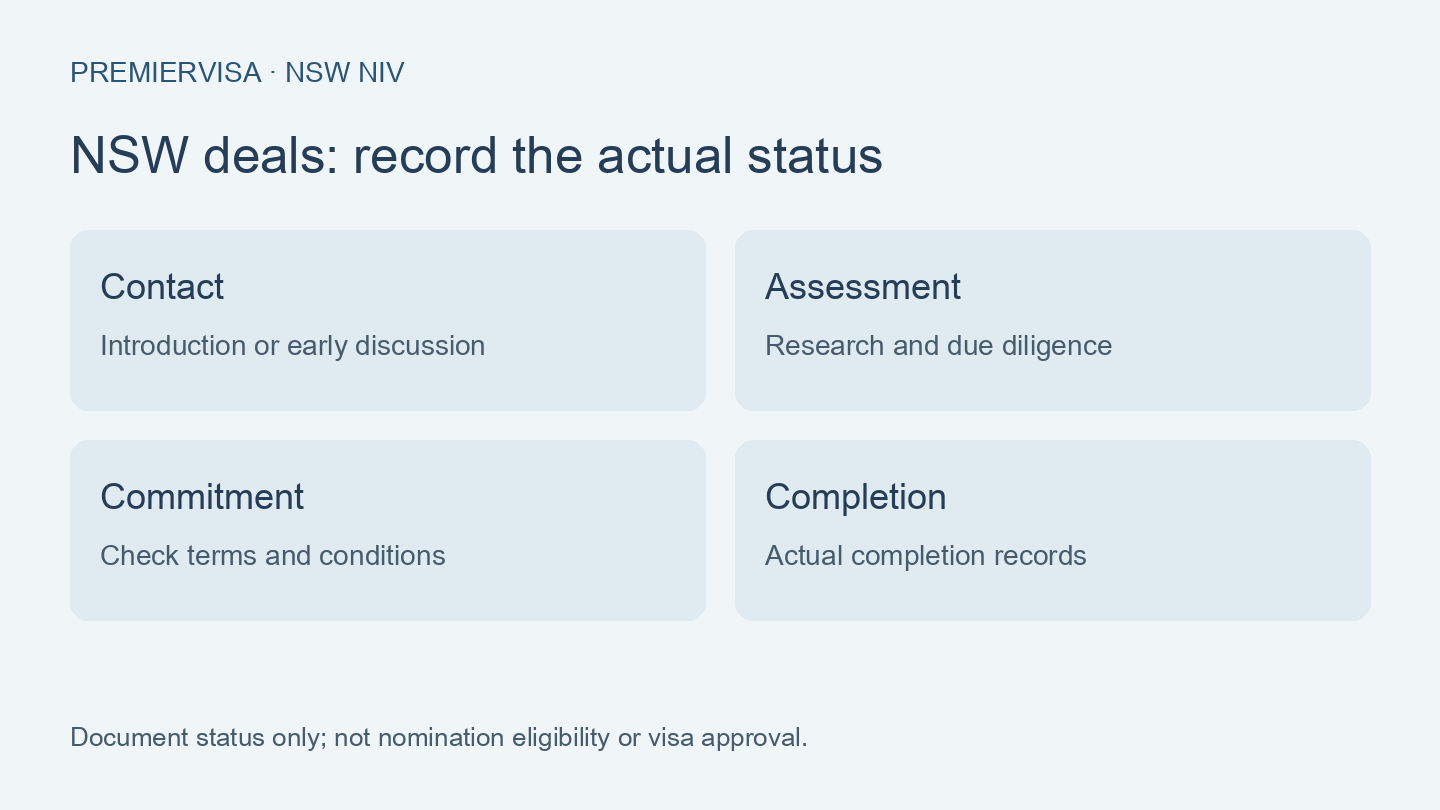
For a private working file, distinguish contact, assessment, commitment and completion using the status that actually applies. This is an organisational method, not a prescribed government investment process or a claim that every opportunity will proceed through the same stages. Receipt of a presentation may establish an initial contact. If terms have not been discussed, the narrative should not turn that contact into an agreed partnership.
Make each opportunity record understandable
Record the entity or identifiable party involved, its connection with NSW, dates of contact, present status and your own work. Explain why you are considering the opportunity: how the technology or business model relates to your experience, what information you have reviewed and what remains uncertain. Keep forecasts separate from events that have already occurred. There is no benefit in describing every enquiry as an imminent success.
Date diligence notes and retain the basis on which they were prepared. If the company later changes its product, fundraising timetable or proposed terms, record the change clearly. Do not rewrite an earlier note to imply you knew information that only became available later. Check disclosure permissions before sharing confidential material. A gap in access cannot properly be filled with an invented meeting record or an unsupported account of progress.
Consistency matters across documents. The pipeline summary, meeting note and company presentation may have been prepared at different times for different purposes. Identify those dates and explain genuine changes rather than forcing all versions to describe the same position. A historical presentation can remain useful context if it is clearly identified as historical, instead of being used as an inaccurate description of the opportunity today.
Do not interchange introductions, intentions and agreements
An introductory email can establish a connection without proving that a company has accepted your investment. Meeting minutes can describe a discussion without establishing a partnership. If documents remain subject to committee approval, diligence or negotiation, retain those qualifications when describing the position. Whether an instrument creates binding legal obligations depends on its substance and applicable law, not merely the filename attached to it.
An opportunity without a completed transaction may still involve real preparatory work. Describe research, professional discussions and analysis already completed, then identify unresolved questions. NSW's ROI guide asks about reasons for choosing the state, existing or planned partnerships and future development. Specific records can help explain those answers more clearly than a generic statement that the Australian market is attractive. NSW — Guide to Registering Your Interest
Keep the evidence exercise separate from a commercial commitment
If someone describes buying a particular product, paying a deposit or transferring funds immediately as a necessary shortcut to an invitation, ask for the specific official basis and the relevant contract or service terms. Migration preparation does not remove ordinary commercial risks. This article does not assess the suitability of an investment or recommend making a transaction to fill a documentation gap.
NSW nomination does not guarantee a visa result; only Home Affairs can grant the visa. A local contact, event attendance or company presentation also should not be treated as proof of international achievement, approved nomination or an invitation. Give each record the evidentiary weight it can actually carry, so an assessment can distinguish supported conditions from questions still requiring investigation. NSW — Common Questions
For an initial discussion, prepare an opportunity index without commercial secrets. Identify the NSW connection, present status, your role and the records you have permission to provide. PremierVisa can help organise the assessment questions. Investment suitability, contractual rights and individual visa eligibility need to be considered within the appropriate professional scope, using the complete facts rather than an optimistic label on a pipeline spreadsheet.
NSW — Guide to Supporting Documents